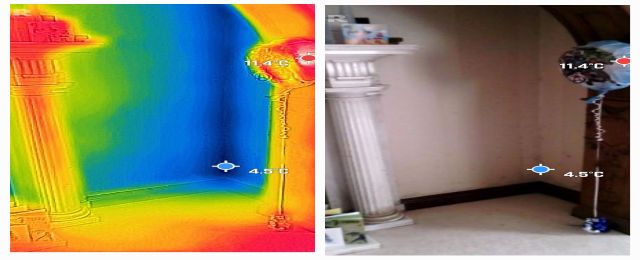
Before: Black Mould forming on a Cold Wall
Prior to thermal plastering installation, mould can be seen forming on a cold wall.

Call Today on 08082508820 * or Book a Survey Online
Condensation is a common problem facing properties across the UK, typically affecting one in five properties every winter.
Excess moisture is created by everyday activities such as cooking, cleaning, showering and even breathing. Normally moisture will remain in the atmosphere, but as the room air temperature drops, the ability of air to hold moisture reduces, and condensation forms on cold surfaces.
In solid wall properties this can often lead to condensation on cold external walls, often north facing, caused by cold bridging.
Our anti condensation thermal plastering can help remove these cold spots, improving the living conditions of the internal environment. It can also help reduce energy bills by improving the thermal values of the walls. Due to the thin insulating tile design, your walls can be insulated without costly alterations to skirting boards, windows, covings and radiators.
Cold bridging (or sometimes known as thermal bridging) are areas of a building that conducts more heat than its surroundings, meaning that heat from within the building can escape. This can be caused by structural defects, gaps in insulation or penetrating damp. As the heat escapes, the surface cools and condensation can form. Many older properties in the UK are constructed with solid walls which can suffer with cold bridging, as they do not have the thermal properties of more modern cavity wall constructed buildings.
In modern buildings, thermal bridging can occur where building elements are not correctly detailed, as may happen if thermal tape is not used to join sections of solid insulation or a vapour control layer. Heat will escape through the join and a line of condensation or mould will form on the surface.
This is further exacerbated by north-facing solid walls that will not get warmed by the sun and will remain cold and become hotspots for mould growth. Cold bridging can lead to energy loss, condensation forming, mould growth and ultimately an unhealthy internal environment.
Cold bridging affecting solid walls can be remedied by increasing the thermal efficiency of the wall, with internal thermal plastering being a simple and effective solution.
Solid wall constructed properties may lack the thermal properties of cavity walls, leading to cold walls that allow condensation to form
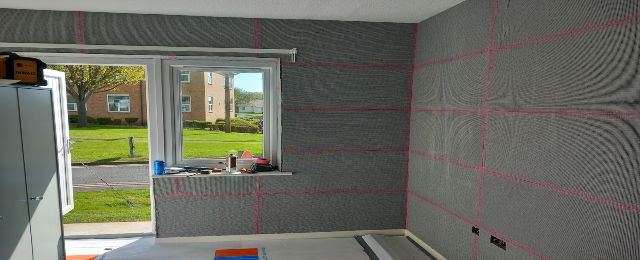
Thermal plastering is a system used to create a barrier between the warm internal environment and the cold external wall by using insulated tiles to reduce heat loss. It is ideal for solid wall properties where it may not be possible to install external insulation and thicker internal insulation would reduce room size beyond an acceptable limit. Thin insulating tiles are placed on walls without the need to make alterations to internal fixings such as skirting boards and covings. The tiles are then plastered over and left ready for decoration. They help reduce condensation forming by removing cold spots and improve the internal environment by eliminating cold patches on walls that allow heat to escape.
Insulated tiles are used to improve the thermal performance of cold external walls that can suffer from condensation and mould problems.
When walls are cold they cause heat to escape, reducing the internal temperature inside the property. If there is warm humid air in a property that is unable to escape via ventilation, this will condense on cold surfaces as water droplets. In time this will ultimately lead to mould growth.
By improving the thermal efficiency of these cold walls it will prevent condensation from forming, while reducing the amount of heat able to escape from the property. This means you can reduce your energy consumption and costs as you require less heating to keep the property warm. Good ventilation is still required to remove excess moisture from the property.
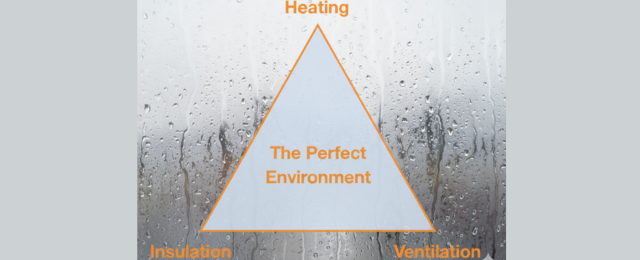
For the optimum internal environment you must get a balance of heating, insulation and ventilation.
This system does not require the installation of a vapour barrier, but if the wall is suffering from penetrating damp, it is recommended that a masonry protection cream is applied.
It is also recommended that air vapour pressure and relative humidity should be controlled within the property through appropriate ventilation. Additional ventilation in the form of trickle vents, air bricks, extractor fans or PIV should be installed as required.
The World Health Organisation suggests indoor air quality in living areas is best around 18-20°C, 50-60% relative humidity and with a minimum 10 litre per second ventilation rate.
The first step is to carry out a condensation survey to fully understand the issues facing your property, before providing recommendations to combat cold bridging, condensation and mould. If the survey finds evidence of cold bridging they will recommend the application of thermal plastering for the affected walls.
Prior to thermal plastering installation, mould can be seen forming on a cold wall.
The tiles are installed on the surface before being plastered. The thermal system can also be installed with or without removing skirting boards and decorative coving by using plaster trim beads.
Plaster is applied to the thermal system tiles. This can then be painted or wallpapered over once the plaster finish is dried.
Condensation is a common problem under bay windows, this is because they are set forward from the rest of the property - meaning they have a reduced thermal efficiency. The temperature of bay windows can drop when temperatures drop outside, or when it's windy. Thermal plastering can help improve thermal efficiency, and stop cold spots.
When you have a problem with cold walls, condensation and mould growth you want advice and solutions that will work long term. This is why you should use a company with qualified and experienced surveyors - this means they have the right training and knowledge to reach the proper diagnosis and provide long term results.
Peter Cox have been the experts in property preservation since 1951 and can provide you with expert advice through a condensation survey, with findings detailed in a survey report.
We will also provide you with condensation control measures to prevent the condensation and mould problem, including the application of thermal plastering, where required.
We have both CSRT and CSTDB qualified surveyors operating from a network of local branches across the UK.
We are a Which? Trusted Trader and we’re rated ‘Excellent’ on Trustpilot with over 2,500
independent customer reviews.
Insulating plaster is a material, applied like traditional plaster, that incorporates insulating aggregates to improve the thermal performance of walls. These can help reduce heat loss, thereby increasing energy efficiency and living comfort. Other systems use insulated tiles which are then directly plastered over.
Yes, insulating plaster systems work by adding a layer of insulation to solid walls that can help improve a property’s thermal performance and energy efficiency while stopping condensation from forming. This will only work for condensation and mould caused by cold bridging, and will not prevent other types of damp. However, if the high moisture levels in the property are not controlled by improved ventilation,condensation may continue to form in other places.
If you are unsure about how to solve a damp wall, you should seek professional advice from a trained professional.
To stop condensation forming on solid brick walls you can use thermal plastering which will
stop warm humid air condensing on the surface through cold bridging. A condensation problem on a wall is caused by moisture laden air so you should attempt to improve ventilation by opening windows and using extractor fans when cooking or showering, covering pans, and avoiding drying clothes indoors. If the problem persists you may require professional advice to fully understand the issue.
*Survey enquiries for your local branch will be directed to our dedicated central survey control teams across the UK. Calls to 0800 and 0808 numbers are free unless you are calling from a business phone, in which case the rate will be set by your provider.