
Call Peter Cox on 08082508820 * or Contact Us Online
Basement Waterproofing Designs to BS8102
If you are considering below ground waterproofing for a basement, cellar or other type of structure, is it important to use a waterproofing system that will keep the interior space dry and fit for purpose. Waterproofing is a complex process that requires qualified surveyors who can design a robust system to the industry code of practice - BS8102.
The British Standard 8102:2022 ‘Protection of Below Ground Structures Against Water Ingress’ is a code of practice which provides recommendations and guidance for waterproofing below ground spaces.
Peter Cox have been carrying out below ground waterproofing across the UK for decades, with CSSW qualified surveyors working out of our network of local branches. We will design and install the systems to adhere to the industry standards and guidelines - including British Standard 8102. A basement waterproofing system designed by a qualified Peter Cox surveyor that complies with BS 8102 standards carries a 10-year guarantee - giving you peace of mind your below ground space is fit for purpose long term.
Basement Waterproofing Regulations
There are multiple regulations a basement waterproofing design must follow in order to prevent moisture ingress, including BS8102, LABC Technical Manual and NHBC Chapter 5.4.
NHBC Chapter 5.4
NHBC Chapter 5.4 is part of the National House Building Council campaign that focuses on problems caused by insufficient waterproofing design and installation. It is used to define when below ground waterproofing systems are required and that a qualified waterproofing expert should be consulted. This gives precedence to the ‘Certificated Surveyor in Structural Waterproofing’ accreditation - which any Peter Cox surveyor will hold when designing below ground waterproofing systems.
Local Authority Building Control Technical Manual
Another guideline used during the design and installation of below ground waterproofing is the LABC Technical Manual. This covers the general requirements for waterproofing, and types of systems that can be used. It stipulates that an approved installer should be used when designing and installing a waterproofing system, reinforcing the guidelines put in place by BS 8102.
What is British Standard 8102?
The British Standard 8102:2022 ‘Protection of Below Ground Structures Against Water Ingress’ is a code of practice which provides recommendations and guidance for waterproofing below ground spaces.
The purpose of this standard is to provide guidance and recommendations for the design, construction, and maintenance of waterproofing systems for structures that are partly or wholly below ground. The framework put together in the document ensures that the waterproofing design chosen is justified for the end use. Its core function is to ensure that underground spaces, such as basements and cellars, remain dry and protected from water and contaminants. The standard outlines a comprehensive risk-based approach to waterproofing. For a dry and habitable living space it is used to ensure a robust waterproofing system is designed and installed.
BS8102 provides details on design factors, grades of protection and the types of waterproofing systems that can be used when preventing moisture in a below ground space. Furthermore, BS8102 was updated in 2022 to reflect new materials and practices in the industry, as well as extending to cover a wider range of structures.
British Standard 8102:2022
British Standard 8102:2022 provided an update on the original standard, stating that all below ground systems should recognise all external sources of moisture, including surface water, flood water and groundwater.
The standard also recommends that a waterproofing design specialist should be consulted at the earliest stage of a project, so that they can make any necessary amendments or approvals that will affect the overall waterproof design.
The document also made changes around the grades of waterproofing. The 2009 version of the standard had three gradings of waterproofing, from some allowance of seepage, to a full and comprehensive waterproofing system, and consideration for the ventilation of habitable spaces.
Grade one in BS 8102:2022 has now been subdivided into two new categories, Grade 1A and 1B.
Another key change from BS 8102: 2009 is the emphasis placed on ensuring that all waterproofing designs should be continuous with the damp proof course level or taken to 150mm above the external ground level.
A section on buried decks below ground level has also been added, which notes the importance of providing waterproofing protection to these, and how they should differ from roofs above ground level.
In regards to servicing and maintenance of Type C Cavity Drainage Membranes, BS 8102:2022 states that these should now have a maintenance schedule, with the first service inspection at handover stage and these details ideally recorded to prove the system is working correctly.
Grades of Waterproofing to BS8102
BS 8102:2022 defines degrees of watertightness in relation to achieving the required internal environmental conditions.
Because certain spaces can allow for varying levels of water ingress, different grades of waterproofing are used. For example a car park or plant room may have different requirements to a domestic basement conversion.
For habitable living such as a domestic basement or cellar conversion, Grade 3 waterproofing is required to prevent any moisture ingress into the internal space.
At the early stages of a project it is important to define what environmental grade is necessary for any given area to ensure that customer expectations of how dry the internal areas will be after waterproofing, is managed and agreed.
-
Grade 1A: - Seepage (slow transmission of water) and damp areas from both internal and external sources are tolerable, if this does not impact the proposed use of the space. Drainage will likely be required.
-
Grade 1B: - No seepage, but damp areas (slightly wet but no transmission) from internal and external sources are tolerable. This means that free water is not allowed to enter but damp patches may occur.
Grades 1A and 1B can be used for car parking, plant rooms (excluding electrical equipment), and workshops etc, depending on the client's remit. -
Grade 2: - No water penetration is acceptable. Damp areas from internal sources are tolerable, ventilation might be required. Grade 2 is used for plant rooms and workshops requiring a drier environment (than Grade 1) and storage areas.
-
Grade 3: - No water penetration acceptable. Ventilation, dehumidification or air conditioning is necessary in the internal space, appropriate to the intended use.Grade 3 is the most common grade and requires a robust waterproofing design. It is typically used for ventilated residential living space and commercial areas, including offices, restaurants and leisure centres.
Types of Basement Waterproofing
BS 8102:2022 categorises three common ways of waterproofing a space into three types, Type A (barrier protection), Type B (structurally integral protection) and Type C (drained protection).
Where Grade 3 protection is required, and the site conditions dictate or the risk of failure is high, the waterproofing design should include a combination of at least two of the types of waterproofing systems.
A CSSW qualified surveyor will be able to design a system using these types of waterproofing, which will provide a dry and habitable space for occupants.
Peter Cox can design practical and effective waterproofing systems for anything from basement conversions to earth retaining walls in new build properties.
Our dedicated waterproofing team can work with you at any stage of your project, whether it be at the start of the project with your architect when creating design plans, or beginning with a survey of an existing structure.
Type A Waterproofing: Barrier Protection (Tanking)
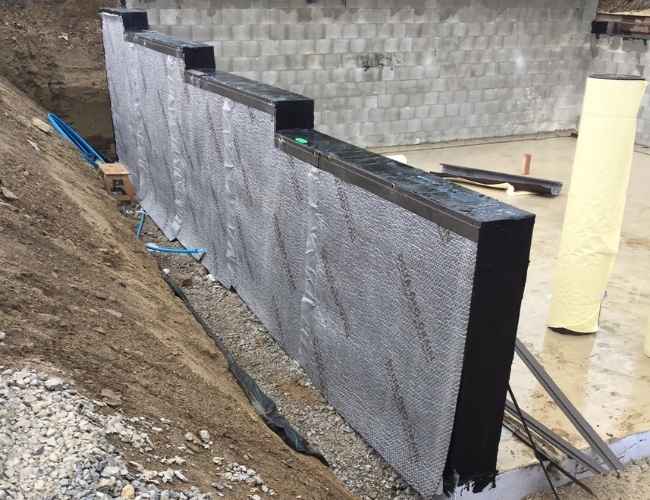
Creating a waterproof barrier using tanking slurries or membranes is a common way to waterproof underground spaces. Type A barrier protection is used to lock down a structure typically by the application of a waterproof material directly onto walls and floors, and can be applied externally and internally, depending on the type of structure.
This method creates a physical barrier between any external water ingress and the walls and floor of your basement or cellar.
It is important to consider the increased pressures on an existing structure when tanking walls and floors. A qualified surveyor will be able to assist by carrying out a waterproofing survey of the property.
Type B Waterproofing: Structurally Integral Protection
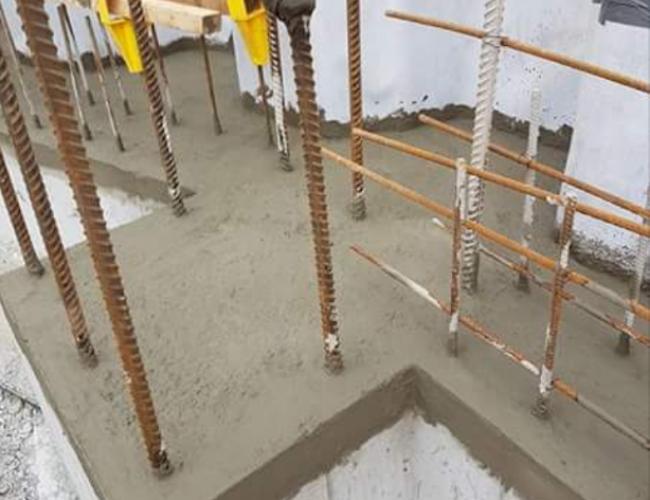
Type B waterproofing involves the structure itself being constructed as an integral water resistant shell and is the primary resistor against water ingress. These are usually well designed and well placed concrete structures poured in situ as a building is constructed.
This usually means a build of reinforced concrete supplemented with a method of controlling water ingress at construction joints, such as a hydrophilic waterbar.
This type of waterproofing method is used during construction and therefore is not typically used for basement and cellar conversions. Peter Cox would need to be involved at the waterproofing design stage to aid in the implementation of Type B Waterproofing.
Type C Waterproofing: Drained Protection
Type C waterproofing systems work by draining water ingress away from a property, so rather than creating a barrier to hydrostatic pressure in the surrounding earth, water ingress is instead permitted to enter the property in a controlled way and then channelled back out.
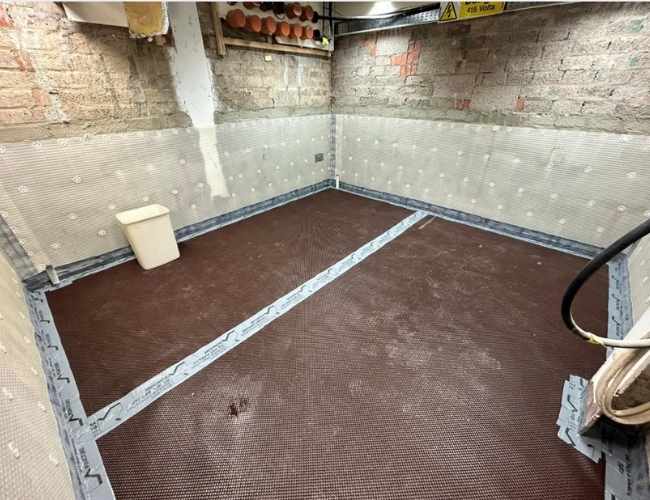
This essentially means that cavity drain membrane (CDM) systems create a water management system with hidden perimeter drainage channels to remove groundwater ingress from the internal environment. It is seen as the failsafe option for below ground waterproofing as it can deal with high levels of moisture penetration and even flooding.
Waterproof membranes are installed on the walls and floors of the basement which are then sealed with waterproof tapes. They then trap any moisture and direct it to the installed drainage channels around the perimeter.
Perimeter drainage channels allow the water to drain away by gravity to a sump chamber incorporating dual pumps, alarm and battery backup system or alternatively via gravity drainage away from the property where topography allows. The internal wall finishes can then be installed by a directly applied plaster where meshed membranes have been utilised. Alternatively waterproof fixing plugs can be utilised to secure battens or a stud frame prior to insulating and dry lining with plasterboard.
Foundation and Floor Waterproofing
To keep water out of a new basement or cellar, it will be necessary to waterproof the concrete foundations or raft floor slabs. The process is similar to waterproofing walls, in that a Type A or a Type B system is required. The most common and effective method of concrete waterproofing is to construct them in Type B concrete or apply a pre-applied Type A waterproofing system. Alternatively post applied Type A slurries and Type C systems could be installed.
Foundation waterproofing can only be installed during the construction of the building, Type A and Type C systems can be retrofitted to solve damp basement problems. A surveyor will be able to provide you with advice on how to waterproof basement and cellar floors as part of a waterproofing system designed to BS8102.
Combined Systems
Where Grade 3 protection is required, and the site conditions dictate or the risk of failure is high, the waterproofing design should include a combination of two or more of the types of waterproofing systems.
Usually a combination of two forms of waterproofing is adequate when designing a habitable space requiring a completely dry internal environment. For most retrofit below ground waterproofing systems it will be a Type A barrier protection system in conjunction with a Type C internal cavity drain membrane system. Type B waterproofing will typically only be used for new builds.
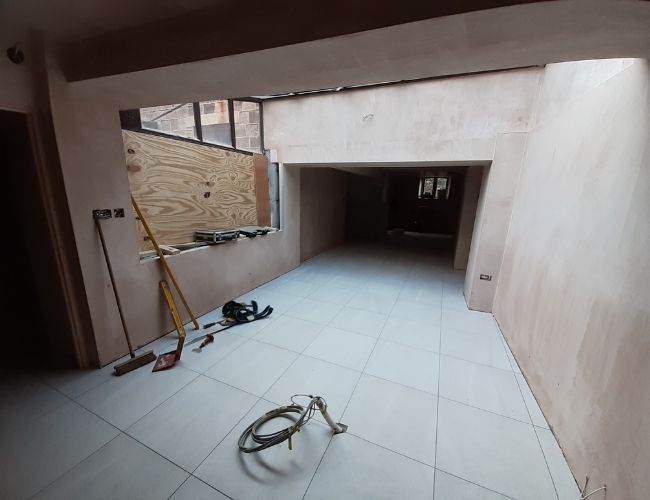
Peter Cox are able to design and install basement waterproofing that complies with BS 8102:2022, backed by a 10 year guarantee. This gives you peace of mind that your waterproof system is fit for purpose and protected long term.
Waterproofing Designs - Choose the Experts
The first step to take when requiring a waterproofing design for a below ground structure is to use a CSSW qualified professional.
Section 4.2 of BS 8102:2022 lays out guidelines for anyone hiring a basement waterproofing contractor. The Guidelines recommend that a waterproofing specialist should be included as part of any underground structural waterproofing design plans and they should meet the following criteria:
- Be suitably experienced in dealing with the type and size of the project
- Be capable of devising solutions that accommodate the projects needs and constraints
- Provide information and guidance on the design, installation and future maintenance of the project
With decades of waterproofing experience, Peter Cox fulfills all these criteria. We have a range of CSSW qualified surveyors working across the country, ready to help you design a basement waterproofing system.
Our frontline CSSW qualified surveyors are supported by our national waterproofing division with decades of experience in structural waterproofing and basement conversions. We can provide you with a basement waterproofing survey, providing you with advice and solutions to turn your damp basement into a habitable space. You will receive a detailed survey report with a waterproofing design specification.
No matter what type of project, we can work with homeowners, architects, contractors and builders to design a waterproofing system to suit your needs. We will be involved through the process step-by-step, from design to completion. Peter Cox are approved installers of Delta, Koster, Newton and Safeguard waterproofing products, and all of our technicians undergo rigorous in-house and onsite training in order to be able to qualify as a trusted partner.
We are rated ‘Excellent’ with over 2,500 independent reviews on Trustpilot and are a Which? Trusted Trader, CHAS and Safecontractor approved.
Waterproofing Design FAQs:
-
How much does it cost to waterproof a basement in the UK?
Every basement waterproofing job is different and the cost will be determined by the size of the property and the type of waterproofing system installed. The best way to accurately quote for a basement conversion is to arrange a waterproofing survey with one of our CSSW qualified surveyors. You will receive a full, thorough and detailed survey report detailing their findings along with a quotation.
-
Does waterproofing a basement really work?
Yes, basement waterproofing is very effective at keeping moisture out, but this depends on the design, installation process and products used. If done incorrectly, waterproofing can fail and moisture or flood water can enter the basement. Basement waterproofing should be designed by a CSSW qualified surveyor, who can design a robust system that factors in hydrostatic pressure and flooding risks.
-
Can I waterproof my basement by myself?
Yes, it is possible to waterproof your own basement with DIY products, however these fixes could fail or be installed incorrectly, allowing moisture inside the basement and causing damage to belongings inside. If you’re wanting to convert your basement into a habitable space, you don’t want to waste time and effort on a system that fails. When waterproofing for habitable living, CSSW qualified surveyors use a combination of two forms of waterproofing to meet BS 8102, and Peter Cox backs this type of work with a 10 year guarantee, so you know your basement is protected long term.
-
What is the best waterproofing for a basement?
The best type of waterproofing depends on the type of building and level of protection necessary. For example, Type A external tanking and Type B integral protection are typically installed during the building process, making them more suitable than other methods. Type A internal tanking and Type C cavity drain membrane systems are more versatile and can be used for basement conversions. Cavity drain systems will typically require sump pumps and drainage channels to manage excess moisture.
Next Steps
*Survey enquiries for your local branch will be directed to our dedicated central survey control teams across the UK. Calls to 0800 and 0808 numbers are free unless you are calling from a business phone, in which case the rate will be set by your provider.