
Call Today on 08082508820 * or Book a Survey Online
Woodworm
Woodworm affects thousands of properties every year, and if left untreated, woodworm infestations can cause significant damage to your property. Woodworm refers to the larvae of any wood-boring beetle, rather than one particular species.
Woodworm larvae will tunnel through furniture, decorative timber and structural timber, meaning that joists, beams and floorboards are at risk.
If you are worried about woodworm affecting your property, we have put together a thorough guide on how to spot a woodworm problem, and the next steps involved.
Peter Cox are the go-to specialists for woodworm and have been providing expert advice and long term solutions for homeowners, commercial clients and social housing providers across the country since 1951.
We have a number of qualified surveyors working from our network of local branches, meaning we can be on hand to diagnose the type of woodworm affecting your property, and provide you with recommendations for treatments, but only if necessary.
With over 70 years’ experience in woodworm treatments, we combine industry-leading standards with local expertise, leaving you with peace of mind the problem is solved.
What is Woodworm?
Woodworm is the common name given to the larvae of various wood-boring beetles that can infest and damage your property.
These beetles lay their eggs on wood, and when the larvae hatch, they tunnel through the timber, feeding on the cellulose within the wood. This feeding process during a woodworm infestation weakens the timber, making it less structurally sound.
Over time this can cause severe damage to furniture and skirting boards, while damage to joists, beams and floor boards can often remain hidden and out of sight.
Because of this, it's crucial for homeowners to recognise the signs of a woodworm problem so they can treat the infestation early and protect their homes from potential damage.
While there are various types of woodworm that affect properties across the United Kingdom, the majority of woodworm damage is caused by the Common furniture beetle, which accounts for around 80% of infestations every year.
Identifying a woodworm species is key, as each species will cause varying levels of damage depending on their life cycle and the size of tunnelling, and because treatment methods vary.
What Does Woodworm Look Like?
Woodworm can often be hard to identify - so rather than spotting adult woodworm that are only present for a short period, often an infestation can be identified by the damage it has caused.
The larvae create tunnels within the wood as they feed. In the case of Common furniture beetle, they tunnel for three to five years and then pupate just below the surface. Out of the pupa emerges an adult beetle and this is what creates the small emergence (flight) hole in the timber surface.
They will then emerge though this newly created hole, as frass from within the larvae tunnel pours out alongside the beetle. These are the dried larval droppings which are noticeable around exit holes and often get caught in cobwebs.
Spotting fully grown beetles or the damage they leave behind are a key indicator, with adult beetles emerging between April and September.
While woodworm beetles vary in size, shape and colour, Common furniture beetles are often dark chocolate brown and have hard wing covers on their back known as elytra.
They are commonly found on window sills as they attempt to fly towards the sunlight, before dying. Common furniture beetles are typically 3-5mm in size.
It is the larva that does the damage to wood. The adults do not feed, except for woodboring weevil adults, which can live for up to a year.
Whether it's damage to timber or the presence of beetles, once you have identified a woodworm problem you may require professional treatments and timber repairs, depending on the extent of the damage.
Signs of Woodworm Damage
Often woodworm damage remains hidden, as the infestation can occur in hard to reach areas like lofts, sub floor voids and behind panelling. That said, there are some key ways to spot the signs of a woodworm infestation in your property, helping you confirm whether or not you require professional assistance.
The most common signs of an active woodworm infestation are:

Small round exit holes (flight holes)
In the case of Common furniture beetle, tiny round holes 1-2mm in diameter are one of the most obvious signs there has been a woodworm infestation.
These flight holes are created when the woodworm larvae pupate and hatch into adult beetles. They will eat their way through the last thin veneer of wood, creating a flight hole from which the adult beetle will crawl out onto the surface of timber to mate with other adult beetles and reproduce. Starting the whole woodworm life cycle all over again.
However it is worth noting that if holes look old and are covered with dust, they could be from an infestation which is no longer active.
Woodworm holes are common in heritage or listed buildings with historic timber, and do not always indicate an active infestation unless accompanied with other signs of woodworm.

Sawdust-like Frass (bore dust)
Frass is the term given to the small, fine and powdery dust that is often found near woodworm flight holes.
These are actually the droppings that the larvae produce as they burrow and chew their way through wood.
If you see any emergence holes in timber then be sure to look for evidence of larval frass, because fresh frass is a key sign that will let you know if the woodworm infestation is currently active.
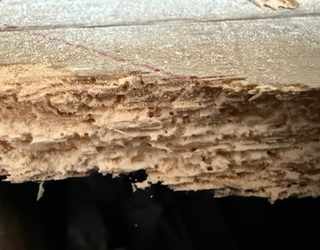
Tunnelling in Wood
Tunnels left by woodworm larvae as they make their way through timber are a clear sign of a woodworm problem.
They are the least visible sign of woodworm as they are contained within timber, and are often only visible once timber is broken open to check.
However, if you do notice tunnels in exposed parts of timber, it could indicate an active infestation, if they look fresh and clean.

Weak, Crumbling and Damaged Timber
Damaged timber is caused by exit holes and tunnels building up to the point where timber becomes structurally unstable.
Often damage is only noticeable when floorboards or joists give way, after the infestation is undisturbed for years.
It is important though not to confuse woodworm damage with damage caused by fungal decay as this requires its own unique and vastly different treatments.
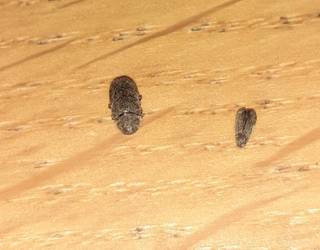
Adult Beetles
Live adult beetles will emerge from timber between April and September, meaning you may spot them around a property as they attempt to crawl or fly away. If the infestation is large enough you may notice many dead beetles on surfaces such as window sills, or on stored goods in the attic.
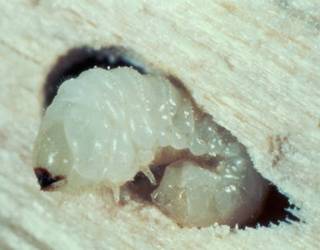
Woodworm Larvae
Possibly the hardest way to identify a woodworm infestation, but one of the most obvious - woodworm larvae. They are creamy white in colour, up to 7mm long and have a curved shape.
Because woodworm larvae remain within timber, if you notice larvae crawling on surfaces it could be another pest such as moth, fly or stored product beetle larvae.
Woodworm Life Cycle
The life cycle of woodworm has 4 stages, and each stage will vary depending on the species of woodboring beetle involved.
Common furniture beetles are the most common type of woodworm in the UK, and cause the most damage to timber every year. While the Common furniture beetle has a life cycle of around 3 to 5 years, other species can be as long as 10 years or more.
Stage one: Common furniture beetle eggs
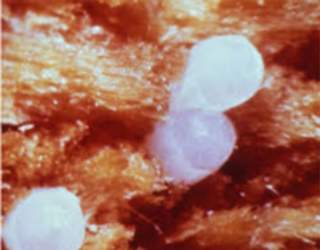
Woodworm Egg Laying
The first stage is when an adult female beetle lays eggs on the surface of wood, usually in open cracks on the surface, where she can anchor the egg. These eggs are only 0.5mm long, so not easy to see. Typically woodworm will not lay eggs on smooth surfaces that have been painted or varnished. If flight holes come through these surfaces, the larvae have bored through from elsewhere.
The common furniture beetle can lay up to 80 eggs in groups of 1 to 4. Because of the number of eggs involved, if left undisturbed, an infestation can become severe.
Stage two: Woodworm Larvae
Larval Tunnelling
Within four to five weeks the eggs will start to hatch. The larvae will then start to bore thorough timber creating tunnels within the wood. The larvae are straight at first and up to 7mm long. As they age, the last three segments curve inwards, forming a crescent. It is during this stage of the woodworm lifecycle that most damage is done. Over time the tunnelling will cause sections of timber to lose its structural integrity and collapse.
Stage three: Pupation
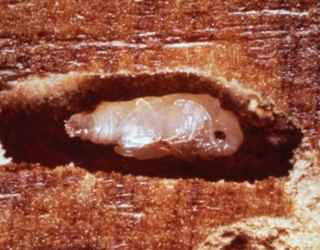
Woodworm Pupation
After the woodworm larvae tunnel through timber for around 3 to 5 years, the larva will start to tunnel towards the surface and then pupate. The larva will take around 2 to 8 weeks to pupate, before the adult beetle emerges on the surface through a newly created flight hole. This is around 2mm in diameter.
Some species pupate in the autumn and over-winter in this state, whilst others pupate in the spring and emerge a few weeks later.
Movement of larvae or adults behind flight holes causes frass to pour out, which is a clear sign that the infestation is active.
Stage four: Adult Common furniture beetles
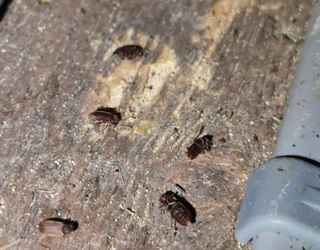
Adult Beetle emerges
The adult beetle will crawl or fly away from the emergence hole in search of a partner to mate with to begin the life cycle again. The adult beetles will typically emerge between April and September and the adult beetle will live for between 20 to 30 days. Other than Woodboring weevils, adult beetles do not feed, so they are on existing fat reserves.
Live or dead beetles are often found near the infestation, typically on window sills or on top of stored goods.
What Causes Woodworm?
While the main cause of wood boring beetle infestations occurs when an adult beetle lays their eggs on a timber surface, which then hatch and tunnel inside, there are other factors that can make a woodworm infestation more likely.
High Humidity and the Moisture Content of Timber: Woodworm larvae require moisture to live, and they obtain this from the wood they ingest. Because of this, the damper the timber, the better the food source, and the more likely a woodworm infestation will occur. Poor ventilation or damp problems can create the right conditions for a woodworm infestation.
Type of Wood: Some woodworm attack softwoods like pine, and others will attack hardwoods such as oak. The Common furniture beetle, which accounts for 80% of all woodworm damage in the UK, will typically eat the younger outer layer of wood (sapwood), as this contains more nutrients. There has been an increase in the amount of sapwood used in timber over the last 100 years as more commercial forests have been developed.
Infested items brought into the house: Many infestations start when stored goods are moved from an attic into a new house, or when buying second hand or antique furniture.
Access via windows: Woodboring beetles do naturally occur in the hedgerows, where they live in decaying trees. Woodworm beetles are most active during the summer, which is when many properties leave windows open, allowing adult beetles to fly into the property.
Untreated timbers: Historic timber that is untreated may be subject to woodworm infestations. More modern properties may have been built with treated timbers, preventing the problem. But throughout, beetle larvae will preferentially attack the nutritious sapwood and damp timbers.
Watch Our Video on How to Spot Woodworm in Your Home
This video player requires JavaScript.
Woodworm Surveys
In order to fully understand if a woodworm infestation is active, you may require professional assistance. This is done through a damp and timber survey, with a CSRT or CSTDB qualified surveyor taking the time to fully investigate the problem, identifying the species involved, and confirming if it is active or not. Woodworm treatments are only required when a woodworm infestation is active.
The surveyor will provide you with a survey report detailing if professional treatments are required, and if there is structural damage to timber that needs to be replaced. Some types of woodworm species require damp timber, and if this is the case, elements of damp proofing may be required.
How to get rid of woodworm
For a confirmed woodworm infestation, you may require professional treatments in order to prevent further damage, and protect your property long term.
Woodworm can damage timber from within by tunnelling, and will often infest timbers that remain out of sight in hard to reach areas, such as lofts, sub floor voids or the underside of floorboards.
If however the woodworm infestation is isolated to small areas, or specifically in antique or second hand furniture which has recently been brought into the home, this may be dealt with by DIY methods.
How is Woodworm Treated Professionally?
Peter Cox are able to provide you with professional woodworm treatments, fully eradicating the infestation, while providing you with a long term guarantee, typically up to 20 years for woodworm.
Insecticide sprays are typically used to eradicate the infestation, breaking the life cycle by killing the egg or as the beetle emerges from the timber. Insecticidal pastes may also be used for some infestations. For severely damaged timber, repairs and timber replacement may be required.
Where the moisture content of timber has increased due to high humidity, damp problems or leaks, these must be addressed. Damp proofing or improvements to ventilation may be required. This is a particular issue in sub-floor spaces.
For historic properties where original timber must be retained where possible, timber resin repairs can also be undertaken.
Is the problem even a woodworm infestation?
Often homeowners or tenants will come across the emergence of insects in their properties over a short period of time, and worry they may have a woodworm infestation.
Because of the increase in popularity of open fires and log burners in homes across the UK, mass emergence is a more regular occurrence.
Hundreds of dead beetles are often found on window sills nearby to the log burner or fires.
In many cases this is not a woodworm problem affecting the structural timber within the home, but an infestation that has been brought into the property inside logs with bark attached.
Typically either Bark beetles or one of many Forest Longhorn beetles are involved. All that is required is to remove the beetles and affected logs outside. Internal timbers are not at risk from these species as they tunnel within the bark. Do not spray the logs with pesticide if you wish to burn them at some point.
Other species of beetle such as Biscuit beetle and Plaster beetle can be found in homes in large quantities, but these require different treatment strategies. Because of this, identification of the type of beetle affecting your property is key, and often this requires professional assistance in the form of a damp and timber survey.
Why Choose Peter Cox for Woodworm?
If you have a suspected woodworm problem and require professional assistance from a qualified surveyor, get in touch with Peter Cox.
We have a number of qualified surveyors operating out of our network of local branches across the UK, ready to provide advice and recommendations for all types of timber problems, including woodworm.
Professional advice can give you the peace of mind of an accurate diagnosis, and if treatments are required they are often backed by our long term guarantees, so you know the problem is solved for good.
Choose Peter Cox for woodworm infestations and benefit from:
-
Decades of property preservation expertise in professional timber treatments and repairs for woodworm
-
Nationwide network of local branches, meaning a local qualified surveyor and technicians in your area.
-
Our trained technicians are equipped with the right equipment and materials to get it right the first time, ensuring your property is restored and the full extent of the woodworm infestation is dealt with.
-
They are equipped with protective floor coverings, Hilti dust extraction units and vacuums in order to keep your property clean and tidy. Where possible they will cover surfaces with dust sheets in order to keep disruption to a minimum.
-
We are a Which? Trusted Trader member
-
Rated ‘Excellent’ on Trustpilot with more than 2,500 independent reviews.
-
Typically our woodworm treatments come with a 20 year guarantee, which will be detailed in the survey report.
Arrange a Woodworm Survey Today
If you suspect that you may have a woodworm issue, then we are here to help.
The most important thing is to correctly diagnose the woodworm problem, and our fully qualified specialist surveyors will be able to do this and recommend the most appropriate course of action.
If necessary, we have a team of experienced technicians ready to get started on repairs and resolve the issue for you.
Woodworm FAQs
As a leading expert in woodworm treatments, we understand your woodworm infestation concerns.
To provide clarity and guidance, our team has compiled answers to frequently asked questions to help you understand and address these issues effectively.
-
Is Woodworm caused by Damp?
Damp problems in your property can contribute to a woodworm infestation and certain types of beetle infestation actively require damp conditions or rotten timber. This is particularly the case with woodboring weevils.
This is why woodworm infestations are often found in parts of the property that are susceptible to high humidity and damp problems such as attics and lofts, under floorboards, basements, bathrooms and crawl spaces.
The types of ventilation problems that can lead to condensation and dry rot can also make a great breeding ground for these wood-boring pests.
-
What time of year does Woodworm spread?
Warmer weather usually heightens the activity of certain types of woodworm and "woodworm/flight season" is generally considered to be between April and September.
While woodworm season (emergence) begins in spring, the woodworm life cycle continues throughout the year, in the form of burrowing larvae. After emergence, the adult beetles seek a mate, lay eggs and die within days to a few months.
-
What does a Woodworm Survey involve?
A woodworm survey from Peter Cox is the first step in addressing a potential woodworm infestation. During the survey, a professional surveyor will visit your property to locate the infestation, accurately identify the species of wood-boring beetle involved, and determine whether the infestation is active.
This assessment is crucial because different beetles may require different treatments. In some cases, the surveyor may need to lift floorboards or access roof voids to fully inspect the affected areas.
-
Does woodworm ever go away?
No, an active woodworm infestation will not usually go away on its own and if left untreated the larvae inside the timber will continue to feed on the wood, which over time may cause structural damage. The infestation could even spread further onto surrounding timber. An active infestation will only die out if they run out of susceptible timber to eat or if the timber is dried, in the case of woodboring weevils.
-
Is woodworm common in the UK?
Yes, woodworm is a common issue for thousands of properties every year. The most common species of woodworm is the Common furniture beetle (Anobium punctatum), which accounts for over 80% of all beetle damage in homes in the UK.
-
Can I ignore woodworm?
If you leave woodworm untreated, the infestation could severely damage timber over a period of time. This could mean that structural timber loses its integrity and could even collapse, which would mean costly repairs.
-
Is woodworm a serious problem?
Yes, woodworm can be a serious problem over time. While small infestations can be easily treated by professional woodworm sprays, if left it could lead to structural damage which may mean timber needs to be removed and replaced.
-
Is woodworm harmful to humans?
No, woodworm are not harmful to humans. The only way they could cause injury to humans is to weaken wood to the point that floorboards or timber joists collapse due to the structural damage.
Next Steps
*Survey enquiries for your local branch will be directed to our dedicated central survey control teams across the UK. Calls to 0800 and 0808 numbers are free unless you are calling from a business phone, in which case the rate will be set by your provider.